
Anxiety disorders are among the most common mental health conditions, affecting millions of adults in the United States every year. For clinicians, anxiety disorders exposure therapy stands out as one of the most powerful, evidence-based tools available. Yet despite decades of research supporting its effectiveness, many therapists hesitate to use it fully due to persistent myths and concerns about client distress.
This comprehensive guide cuts through the misconceptions and provides a practical, research-informed roadmap for implementing anxiety disorders exposure therapy effectively and ethically. Whether you work with panic disorder, social anxiety, OCD, generalized anxiety disorder (GAD), specific phobias, or PTSD, understanding how to harness exposure techniques can transform outcomes for your clients.
Exposure therapy is not about forcing clients into overwhelming situations or “tough love.” When delivered skillfully—with proper assessment, collaborative hierarchy building, and attention to inhibitory learning—it helps clients discover that their feared outcomes are either unlikely or manageable. The result is often profound and lasting relief.
In the sections below, we’ll explore what exposure therapy really is, debunk the most common myths with evidence, review authoritative U.S. guidelines, outline detailed best practices, and show how to tailor approaches to specific anxiety presentations. We’ll also highlight professional development opportunities, including relevant CE trainings offered by Clinical Events.
What Is Exposure Therapy for Anxiety Disorders?
Anxiety disorders exposure therapy is a structured, evidence-based behavioral intervention that helps individuals confront feared stimuli, situations, sensations, thoughts, or memories in a safe, controlled, and repeated manner. The core mechanism involves new learning: clients experience that the anticipated catastrophe does not occur (or is tolerable), which weakens the fear association over time.
This process draws on principles of habituation (anxiety naturally decreases with prolonged exposure) and, more modernly, inhibitory learning (creating new, competing safety memories that inhibit old fear responses). Emotional processing theory and the inhibitory learning model both explain why repeated, varied exposures without safety behaviors lead to robust, generalizable change.
There are several main types of exposure used across anxiety disorders:
- In vivo exposure: Facing real-life feared situations (e.g., public speaking for social anxiety or riding elevators for claustrophobia).
- Imaginal exposure: Vividly recounting or writing about feared scenarios or memories (central to Prolonged Exposure for PTSD).
- Interoceptive exposure: Deliberately inducing feared bodily sensations (e.g., hyperventilating or spinning to confront panic-related dizziness or heart racing).
- Virtual reality exposure: Using immersive technology for phobias or social situations when in vivo practice is impractical.
- Exposure and Response Prevention (ERP): The gold-standard behavioral component for OCD, combining exposure to obsessional triggers with prevention of compulsive rituals.
Exposure can be delivered as a standalone treatment or, more commonly, as a key component within Cognitive Behavioral Therapy (CBT) protocols. It is highly adaptable—graded (starting low on a hierarchy), flooding (starting at high intensity, less common now), or massed versus spaced sessions.
Clinicians often combine exposure with psychoeducation, cognitive restructuring (before or after exposures), and skills for managing high arousal when needed. The goal is not zero anxiety during exposure but learning that anxiety is temporary and that the client can cope effectively.
Debunking Common Myths About Anxiety Disorders Exposure Therapy
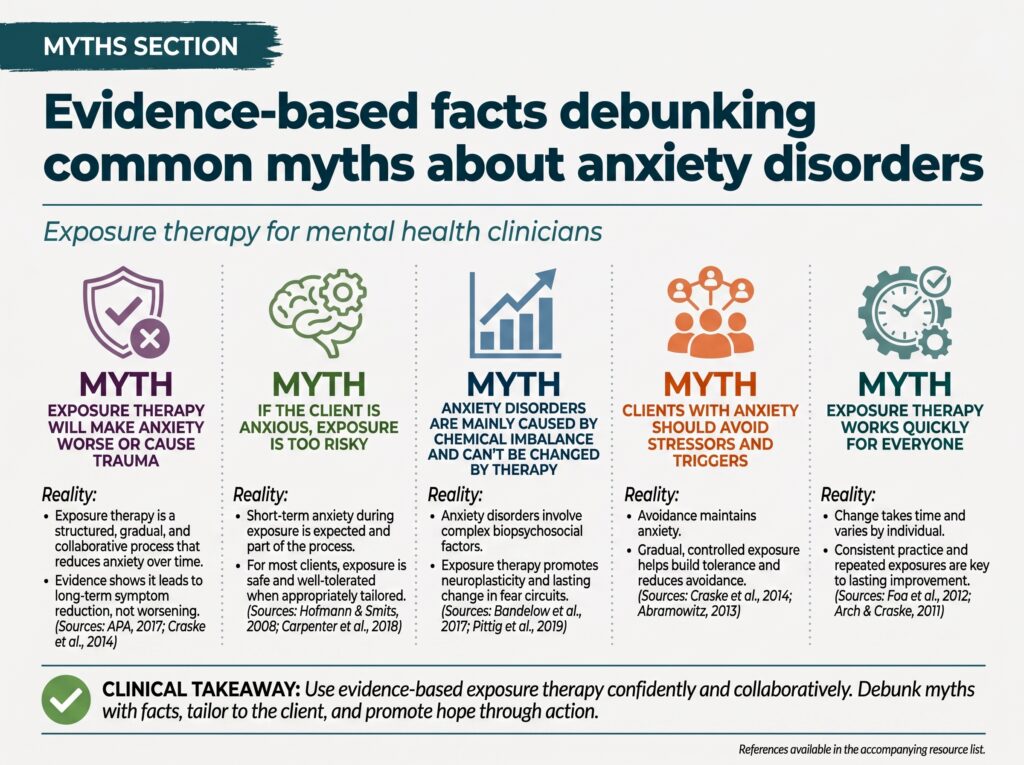
Despite strong evidence, several myths continue to limit the use of anxiety disorders exposure therapy. Here are the most prevalent ones, along with research-backed clarifications:
Myth 1: Exposure therapy will make anxiety worse or cause lasting harm.
In reality, anxiety often increases temporarily during an exposure but reliably decreases within and across sessions through habituation and new learning. Studies consistently show that properly conducted exposure does not lead to symptom worsening or increased dropout rates compared to other active treatments. Clients frequently report a sense of mastery and reduced fear after successful exposures.
Myth 2: It’s just “facing your fears” without structure or support.
Effective exposure is highly structured. It begins with thorough assessment and collaborative hierarchy development using Subjective Units of Distress (SUDS) ratings (0–100 scale). Exposures are planned, repeated, and processed afterward to consolidate learning. Safety behaviors (subtle avoidance or escape strategies) are systematically faded. This is far from unstructured confrontation.
Myth 3: Relaxation or safety behaviors should always be used during exposure.
While grounding or breathing skills have a place in stabilization phases, using them during peak exposure can interfere with inhibitory learning. Clients need to experience the full arc of anxiety rising and falling without escape to form new safety associations. Cognitive strategies are often more useful before or after exposures.
Myth 4: Exposure therapy is only suitable for simple phobias.
Anxiety disorders exposure therapy is a first-line or core component for panic disorder, social anxiety disorder, OCD (via ERP), GAD (worry exposure and behavioral experiments), and PTSD (Prolonged Exposure or Written Exposure Therapy). It is effective across the anxiety spectrum when adapted appropriately.
Myth 5: Clients will drop out because it’s too distressing.
While some initial hesitation is normal, dropout rates for exposure-based treatments are generally comparable to or lower than other evidence-based therapies when clients receive proper preparation and a strong therapeutic alliance. Many clients prefer active, structured approaches once they understand the rationale.
Myth 6: Exposure therapy ignores thoughts and emotions.
Modern exposure work integrates cognitive elements. Clinicians help clients test predictions (“What do you expect will happen?”) and process disconfirming evidence afterward. It is not purely behavioral; it targets both fear structures and meaning-making.
Myth 7: You need years of specialized training before using any exposure techniques.
While advanced training and consultation improve outcomes and ethical practice, many core exposure principles can be learned through targeted CE programs and applied thoughtfully. Starting with lower-intensity exposures and seeking supervision is a responsible path for clinicians building competence.
These myths often stem from outdated portrayals or incomplete training. When clinicians understand the science and follow best practices, anxiety disorders exposure therapy becomes a collaborative, empowering process rather than a source of fear for either party.
The Strong Evidence Base from Authoritative U.S. Sources
Anxiety disorders exposure therapy is not experimental—it is one of the most researched psychological interventions. Authoritative U.S. organizations strongly endorse it.
The American Psychological Association (APA) describes exposure therapy as a psychological treatment developed to help people confront their fears. It has demonstrated effectiveness for phobias, panic disorder, social anxiety disorder, obsessive-compulsive disorder, posttraumatic stress disorder, and generalized anxiety disorder.
The U.S. Department of Veterans Affairs (VA) PTSD National Center highlights Prolonged Exposure (PE) as having the strongest recommendation across clinical practice guidelines for PTSD. PE and other exposure-based approaches show high strength of evidence for reducing PTSD symptoms, even in complicated presentations with comorbidities.
APA’s Clinical Practice Guideline for the Treatment of Posttraumatic Stress Disorder recommends trauma-focused cognitive behavioral therapies, including exposure elements, as first-line interventions.
Meta-analyses and dismantling studies further support specific components: interoceptive exposure is particularly helpful for panic, in vivo and behavioral experiments for social anxiety, and ERP for OCD. Long-term follow-up data show durable gains, with many clients maintaining improvements months or years later.
Exposure-based treatments often outperform or equal pharmacological options in head-to-head trials for many anxiety disorders, with better maintenance of gains and fewer side effects. They are cost-effective and can be delivered in individual, group, or intensive formats.
These U.S.-based guidelines and reviews (APA, VA) provide clinicians with confidence that anxiety disorders exposure therapy, when implemented with fidelity, is among the most effective tools available.
Best Practices for Delivering Anxiety Disorders Exposure Therapy
Implementing anxiety disorders exposure therapy successfully requires attention to several key elements. Here is a practical, step-by-step framework:
- Conduct Thorough Assessment and Build Alliance — Screen for trauma history, dissociation, suicidal ideation, and medical contraindications (e.g., certain cardiac conditions for intense interoceptive work). Explain the rationale clearly and collaboratively.
- Provide Psychoeducation — Teach clients about the anxiety cycle, the role of avoidance in maintaining fear, and how exposure creates new learning. Use simple metaphors (e.g., “anxiety is like a false alarm”).
- Develop a Collaborative Hierarchy — Work with the client to list feared situations/sensations and rate them on a SUDS scale. Start with items rated 30–50 and progress upward.
- Plan Exposures Carefully — Define the exposure clearly (what, where, how long, what to notice). Decide on duration (until anxiety decreases by at least 50% or a set time) and whether to include response prevention.
- Eliminate or Fade Safety Behaviors — Identify subtle strategies (checking, reassurance-seeking, mental rituals, distraction) and plan to block or reduce them during exposure.
- Conduct the Exposure — Stay present with the client. Encourage them to notice thoughts, feelings, and sensations without judgment. Avoid excessive reassurance or rescue.
- Process and Consolidate Learning — After the exposure, debrief: What happened vs. what was predicted? What new information was learned? Rate new SUDS and update the hierarchy.
- Assign Between-Session Practice — Homework is essential. Encourage repeated, varied exposures in different contexts to promote generalization.
- Monitor Progress and Adjust — Use objective measures (e.g., anxiety scales, behavioral approach tests) and adapt pacing based on client response.
- Address Common Challenges — If anxiety does not decrease, check for hidden safety behaviors, insufficient duration, or cognitive fusion. If distress is too high, add preparatory skills or lower the intensity temporarily.
Additional tips include starting with easier successes to build momentum, varying exposures to prevent context-specific learning, and integrating values-based motivation (“What is important enough to face this fear for?”).
Ethical practice includes ongoing informed consent, monitoring for any signs of harm, and referring out or seeking consultation when cases exceed your current competence.
Tailoring Exposure to Specific Anxiety Disorders
Panic Disorder and Agoraphobia: Interoceptive exposure is highly effective. Clients practice inducing sensations like rapid heartbeat or dizziness (through running in place, spinning, or straw breathing) while dropping safety behaviors. In vivo work then addresses agoraphobic avoidance.
Social Anxiety Disorder: In vivo exposures target feared social situations (conversations, presentations, eating in public). Behavioral experiments test specific predictions. Video feedback and external mindfulness can enhance outcomes.
Obsessive-Compulsive Disorder (OCD): Exposure and Response Prevention (ERP) is the behavioral gold standard. Clients face obsessional triggers (contamination, harm thoughts, checking urges) while refraining from compulsions. Hierarchies are carefully constructed around obsession severity and interference.
Generalized Anxiety Disorder (GAD): Worry exposure involves writing or recording worries and sitting with the uncertainty. Behavioral experiments test “what if” scenarios. Intolerance of uncertainty is often a key target.
Specific Phobias: Graded in vivo or virtual reality exposure works rapidly for many (e.g., flying, heights, animals). Single-session intensive protocols can produce strong results.
Posttraumatic Stress Disorder (PTSD): Prolonged Exposure includes imaginal revisiting of the trauma memory and in vivo confrontation of avoided reminders. Written Exposure Therapy is a briefer alternative with growing support.
Across disorders, the principles remain consistent while the content of exposures is individualized.
A Detailed Case Example
Consider “Maria,” a 34-year-old woman with panic disorder with agoraphobia and comorbid social anxiety. She avoided driving on highways, crowded stores, and social gatherings due to fear of panic attacks and embarrassment.
After thorough assessment and psychoeducation, Maria and her therapist built a hierarchy. Early exposures included interoceptive work (hyperventilating while dropping safety behaviors like checking her pulse). Anxiety rose but fell within 10–15 minutes as she learned the sensations were not dangerous.
Later sessions moved to in vivo practice: sitting in a café for increasing durations without escape plans, then driving short highway segments. Each exposure was followed by processing: “What did you learn about your ability to handle panic sensations?” and “Did the feared catastrophe happen?”
Over 12 sessions, Maria’s panic attacks decreased dramatically, she resumed driving and social activities, and her confidence grew. Homework practice between sessions accelerated progress. This case illustrates collaborative planning, elimination of safety behaviors, repeated practice, and integration of cognitive processing—all hallmarks of effective anxiety disorders exposure therapy.
Challenges, Contraindications, and Ethical Considerations
While highly effective, exposure is not appropriate for every client at every stage. Relative contraindications or modifications may be needed for active psychosis, severe dissociation, uncontrolled substance use, or certain medical conditions. In such cases, prioritize stabilization first (e.g., somatic regulation skills or polyvagal-informed work).
Common challenges include client resistance (address with motivational interviewing and values exploration), therapist discomfort (mitigated by training and supervision), and incomplete response (often due to subtle safety behaviors or insufficient repetition).
Ethically, clinicians must obtain ongoing informed consent, monitor distress levels, avoid coercion, and practice within their competence. Cultural sensitivity is essential—adapt language, examples, and pacing to the client’s background and values.
Integrating Exposure with Other Approaches
Anxiety disorders exposure therapy integrates beautifully with other modalities. Within CBT, cognitive restructuring prepares clients and processes learning. Somatic and polyvagal-informed techniques can help clients stay within their window of tolerance during high-arousal exposures. Internal Family Systems (IFS) or parts work can address protective parts that resist exposure.
The Deconstructing Anxiety model (featured in Clinical Events training) helps identify core fears beneath symptoms, which can sharpen exposure hierarchies and deepen meaning-making work.
Many clinicians use a phased approach: stabilization and skills building → targeted exposure → consolidation and relapse prevention.
Professional Development: Build Your Skills with Clinical Events
Staying current with best practices in anxiety disorders exposure therapy requires ongoing training. Clinical Events offers high-quality, live virtual CE trainings designed specifically for licensed mental health professionals.
Don’t miss this upcoming training:
📅 July 25, 2026 | 10:00 AM – 4:45 PM EST | 6 CE Credits
Speaker: Todd Pressman, PhD
This full-day program goes beyond DSM labels to explore core fears and defenses driving anxiety presentations and equips you with practical strategies that complement and enhance exposure work.
Explore all upcoming live CE events and earn credits while advancing your clinical skills:
Conclusion
Anxiety disorders exposure therapy is a cornerstone of effective treatment for panic, social anxiety, OCD, GAD, phobias, and PTSD. By moving beyond myths and embracing evidence-based best practices—collaborative assessment, structured hierarchies, elimination of safety behaviors, repeated and varied practice, and thoughtful processing—clinicians can help clients achieve meaningful, lasting change.
The research from leading U.S. organizations like the APA and VA is clear: when delivered skillfully, exposure works. The key is preparation, pacing, and a strong therapeutic relationship.
Whether you are new to exposure or looking to refine your approach, investing in targeted training will enhance both your confidence and your clients’ outcomes. Clinical Events is here to support your professional growth with expert-led CE opportunities.
Ready to deepen your expertise in treating anxiety disorders? Register for upcoming trainings and continue providing the highest standard of care.
FAQ
What is anxiety disorders exposure therapy and how does it work?
Anxiety disorders exposure therapy is a structured behavioral treatment that helps clients systematically confront feared situations, sensations, or memories. Through repeated practice without safety behaviors, clients learn that their feared outcomes are unlikely or tolerable, creating new safety memories that reduce anxiety over time.
Is exposure therapy safe? Does it make anxiety worse?
When conducted properly with assessment, preparation, and pacing, exposure therapy is safe and effective. Temporary increases in anxiety are expected and part of the learning process; long-term outcomes show significant reduction in symptoms for most clients.
How long does exposure therapy for anxiety disorders typically take?
Duration varies by disorder and client. Many see substantial improvement in 8–16 sessions. Some phobias respond in fewer intensive sessions, while complex or comorbid presentations may require more time or phased treatment.
Can exposure therapy be combined with medication or other therapies?
Yes. It integrates well with CBT, somatic regulation skills, and, when appropriate, medication. Many clients benefit from combined approaches, especially in the early stages of treatment.
What training do therapists need to deliver exposure therapy ethically?
Core principles can be learned through targeted CE programs, workshops, and supervision. Advanced competence in specific protocols (e.g., Prolonged Exposure, ERP) benefits from specialized training and consultation. Always practice within your scope and seek support for complex cases.
Which anxiety disorders respond best to exposure therapy?
Strong evidence supports exposure-based approaches for panic disorder, social anxiety disorder, OCD (ERP), specific phobias, GAD, and PTSD. Adaptation to the specific presentation is key to success.
What if my client refuses exposure or finds it too distressing?
Start with thorough psychoeducation and motivational work. Begin with very low-intensity exposures or behavioral experiments. Address underlying concerns compassionately. Some clients need preparatory stabilization before full exposure work.
Are there any situations where exposure therapy should be avoided?
Relative contraindications include active severe psychosis, uncontrolled substance use, or certain medical conditions that make intense physiological arousal unsafe. In these cases, prioritize stabilization and consult with medical providers or specialists.

No comment yet, add your voice below!