Introduction
When clients come to therapy with anxiety, they often describe elaborate strategies they’ve developed to avoid feeling fear. They may overprepare, avoid triggers, or seek constant reassurance. While these defenses provide short-term relief, they almost always reinforce anxiety in the long run.
The Deconstructing Anxiety model, developed by Todd Pressman, PhD, explains this paradox: defenses are designed to protect against core fears, but in doing so, they keep clients trapped in the very cycle they’re trying to escape.
What Are Defenses?
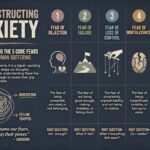
From a psychodynamic perspective, defenses are psychological strategies used to ward off uncomfortable feelings or thoughts. In the Deconstructing Anxiety model, defenses are viewed as protective behaviors developed to avoid one of the five core fears:
- Abandonment (loss of love)
- Loss of identity
- Loss of meaning
- Loss of purpose
- Fear of death
Common Defenses in Anxiety
- Perfectionism: Attempting to control outcomes to avoid loss of identity or purpose
- Avoidance: Staying away from triggers to suppress fear of rejection or death
- Over-control: Rigid routines or rules to manage uncertainty
- Distraction: Excessive work, screens, or substances to escape uncomfortable emotions
- Reassurance-seeking: Constantly checking with others to avoid abandonment fears
While these strategies may provide temporary relief, they require enormous energy and ultimately strengthen the underlying fear.
Why Defenses Fail
- Short-term comfort, long-term cost
- Defenses create the illusion of safety but reinforce avoidance.
- Narrowing of life
- Clients spend increasing time and energy maintaining defenses, reducing freedom.
- Fear becomes more powerful
- Avoiding a fear teaches the brain that the feared situation is dangerous, making anxiety worse.
Breaking the Cycle: “Doing the Opposite”
The Deconstructing Anxiety model teaches that true freedom comes when clients are supported to do the opposite of their defenses.
Examples:
- A perfectionistic client experiments with allowing small mistakes → learns self-worth is not contingent on flawlessness.
- An avoidant client attends a feared social event → discovers connection despite anxiety.
- A reassurance-seeking client delays checking in → develops confidence in self-trust.
This approach mirrors CBT’s exposure therapy but goes a step further by connecting actions to existential fears and core defenses.
Clinical Example
Client: “Mark,” 45, struggled with chronic worry and insomnia.
- Defense: Over-control — planning every detail of his day to avoid uncertainty.
- Core Fear: Loss of meaning (“If I can’t control everything, my life will fall apart”).
- Intervention: Practiced deliberately leaving parts of his schedule unplanned.
- Outcome: Reported reduced anxiety and increased spontaneity, along with a renewed sense of purpose.
Therapist Tips
- Map out client defenses and identify the “price” of maintaining them.
- Normalize defenses as adaptive but costly strategies.
- Encourage small, structured experiments in “doing the opposite.”
- Provide support, validation, and debriefing as clients confront fears.
Conclusion
Defenses feel safe, but they keep clients imprisoned in cycles of anxiety. By helping clients recognize defenses and gently guiding them to do the opposite, clinicians can unlock transformation and freedom.
👉 Want to learn practical tools for identifying and reversing defenses in session? Join Dr. Todd Pressman for a live, 3-hour on Sept. 20, 2025: [Register Here]